


Business banking guide •
An ABA routing number is a nine-digit code that identifies a U.S. financial institution when checks and electronic payments are processed. This guide explains what an ABA routing number is, whether an ABA number is the same as a routing number, where the routing number appears on a check, and how to choose the correct number for direct deposit, ACH payments, or wire transfers.
Reviewed against official American Bankers Association and Federal Reserve resources: August 2026
Free ABA bank finder
Find a Bank by Routing Number
Enter a nine-digit ABA routing number—also called a bank routing number or routing transit number—to identify the financial institution associated with it.
- Enter all nine digits. They are usually at the bottom-left of a check.
- Select “Look Up Bank.” We check the ABA format and search the directory.
- Verify before sending money. ACH, check, and wire numbers can differ.
Important: This tool identifies the institution tied to a routing number; it does not verify an account or confirm the correct number for a specific payment. Results come from independent directory sources and may not include every active routing number. Always confirm with the bank or the official ABA resource. Directory sources: BankRouting.io and US Bank Locations.

Setting up a business bank account or managing a cash-flow gap?
Excel Capital helps established businesses compare funding options for payroll, materials, inventory, equipment, and other operating needs.
Financing is subject to underwriting, approval, product availability, and provider requirements.
What Is an ABA Routing Number?
An ABA routing number is a nine-digit number used to identify the bank or credit union responsible for receiving, paying, or settling a U.S. check or electronic payment. The term “ABA” refers to the American Bankers Association, which developed the routing-number system more than a century ago.
You may also see the number called a routing number, routing transit number, RTN, bank routing number, or ABA number. The routing number points the payment system to the financial institution. Your separate account number tells that institution which checking or savings account should receive or send the money.
Always nine digits
A standard ABA routing number contains exactly nine numeric digits.
Identifies the institution
It identifies the bank or credit union responsible for the transaction—not your individual account.
Used in U.S. payments
ABA routing numbers support domestic check and electronic-payment processing.
Works with an account number
The routing number directs the payment to the institution; the account number directs it to the account.
The American Bankers Association explains that the routing number’s primary purpose is to identify the institution responsible for a check or electronic transaction. That makes it similar to a destination code within the U.S. banking system, but it does not identify the account holder.
Is an ABA Number the Same as a Routing Number?
Yes—an ABA number and a routing number generally mean the same thing. “ABA routing number” is the formal industry term, while banks, employers, payment forms, and banking apps often shorten it to “routing number.” “Routing transit number” or “RTN” is another common name for the same nine-digit identifier.
| Term You May See | What It Usually Means | Important Qualification |
|---|---|---|
| ABA number | A nine-digit U.S. routing number. | Usually interchangeable with “routing number.” |
| ABA routing number | The formal name for the nine-digit bank identifier. | A bank can have more than one. |
| Routing transit number (RTN) | Another name for an ABA routing number. | Often used on forms and in banking documentation. |
| ACH routing number | The routing number designated for ACH credits and debits. | It may or may not match the number used for wires. |
| Wire routing number | The number a bank designates for domestic wire transfers. | Do not assume it is the number printed on a check. |
Where Is the Routing Number on a Check?
On most personal checks, the routing number is the first nine-digit group printed at the bottom left. It appears in the MICR line—the machine-readable row of routing, account, and check information along the bottom edge. The American Bankers Association describes the ABA routing number as the left-most number, followed by the account number and then the check number.
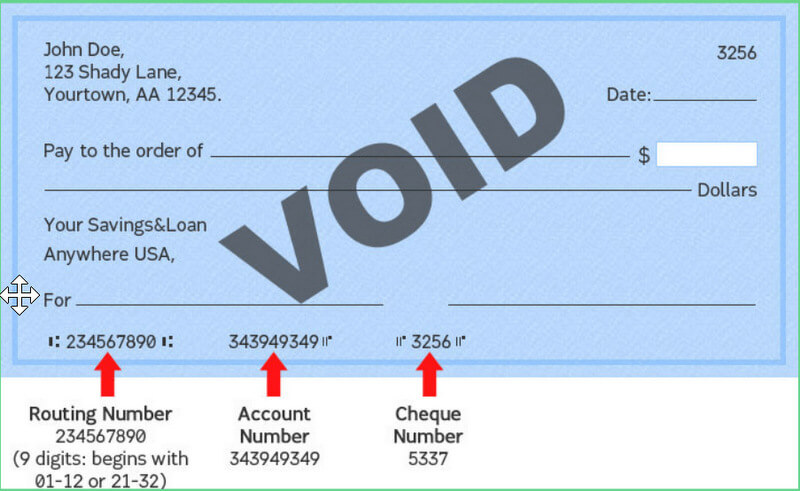
Routing number
The first nine-digit group on the lower left identifies the financial institution.
Account number
The next group identifies your specific checking account and can vary in length.
Check number
The shorter final group identifies the individual check and usually matches the number near the top right.
The small MICR symbols surrounding each number group are not part of the routing number. Business-check formats and certain check designs can vary, so confirm that the number contains exactly nine digits before entering it.
How to Find Your ABA Routing Number
You do not need a paper check to find an ABA routing number. The most reliable method is to use your bank’s authenticated app or online-banking account because it can display the routing number assigned to your specific account and transaction type.
Some bank statements, deposit slips, direct-deposit forms, or account-opening documents may also display a routing number. Because banks can maintain multiple routing numbers, do not rely on an unaffiliated third-party list when the payment is large, urgent, or difficult to reverse.
Which ABA Routing Number Should You Use?
The correct routing number depends on the payment rail. A number that works for direct deposit may not be the bank’s domestic-wire number. The safest approach is to identify the transaction first and then use the routing instructions published for that specific account.
Direct Deposit or Autopay
Use the bank’s ACH or electronic routing number shown for the account.
Checks or Check Orders
Use the routing number printed on the check or confirmed for paper transactions.
Domestic Wire Transfer
Use the bank’s domestic-wire routing number and follow its wire instructions.
International Transfer
Ask for the required SWIFT/BIC and country-specific account details; an ABA number alone may not be enough.
| Transaction | Number or Identifier Commonly Needed | Best Place to Confirm It |
|---|---|---|
| Payroll direct deposit | ACH/electronic routing number + account number | Account details or direct-deposit form in the bank app |
| Automatic bill payment | ACH/electronic routing number + account number | Bank app or online banking |
| ACH transfer between banks | ACH routing number + account number | Receiving bank’s authenticated account details |
| Paper check | Routing number printed in the check’s MICR line | The check and the issuing bank |
| Domestic wire transfer | Domestic-wire ABA routing number + wire instructions | Receiving bank’s official wire instructions |
| International transfer | Often SWIFT/BIC plus an account number or country-specific identifier | Receiving bank’s international-wire instructions |
How an ABA Routing Number Works
When a payment instruction is submitted, the routing number identifies the financial institution responsible for receiving or paying the transaction. The account number then identifies the individual account within that institution. Payment systems use both values to direct and settle the transaction.
The official ABA routing-number structure divides the nine digits into three components:
ANATOMY OF A NINE-DIGIT ABA ROUTING NUMBER
Digits 1–4
Digits 5–8
Digit 9
The final digit is a mathematical check digit used to help detect data-entry errors in the preceding digits.
1. Federal Reserve Routing Symbol: Digits 1–4
The first four digits form the Federal Reserve routing symbol. The first two digits fall within number ranges assigned for particular classes of routing numbers, while the full four-digit symbol is part of the institution’s routing identity.
2. ABA Institution Identifier: Digits 5–8
The next four digits identify the institution within the routing-number structure. They should not be treated as a customer’s branch number or account number.
3. Check Digit: Digit 9
The final digit is calculated from the first eight digits. Payment systems can use it to flag a routing number that was typed incorrectly.
ABA Routing Number vs. Account Number vs. Check Number
The routing number and account number often appear together, but they serve different purposes and should not be confused.
| Number | What It Identifies | Typical Length | How Sensitive Is It? |
|---|---|---|---|
| ABA routing number | The financial institution and payment endpoint | Exactly 9 digits | Widely available, but still verify before use |
| Bank account number | Your specific checking or savings account | Varies by institution | Private financial information |
| Check number | The individual paper check | Varies; usually shorter | Less sensitive by itself |
| Debit-card number | The payment card connected to the account | Usually 16 digits | Highly sensitive card information |
The routing number itself is commonly published because many customers at the same institution may use it. Your account number is unique to your account and should be shared only through trusted, secure channels. A routing number combined with an account number can be used to initiate certain bank-account transactions, so treat the pair as sensitive banking information.
What Is an ABA Routing Number Used For?
Routing numbers help banks and payment systems process several common types of domestic transactions. The Consumer Financial Protection Bureau explains that ACH transfers include direct deposits and recurring debits that use a bank routing number together with an account number.
Direct deposit
Receive payroll, benefits, tax refunds, or other eligible electronic deposits.
Automatic payments
Authorize recurring ACH debits for utilities, vendors, rent, taxes, or subscriptions.
Bank-to-bank ACH transfers
Move money between eligible accounts through the Automated Clearing House network.
Check processing
Direct a paper check to the financial institution responsible for payment.
Domestic wires
Identify the receiving institution when the bank designates that ABA number for wires.
Why Can One Bank Have More Than One Routing Number?
A large bank can maintain multiple routing numbers. The American Bankers Association’s routing policy permits eligible institutions to receive a principal routing number and additional numbers, subject to policy limits and approval requirements.
Common reasons include:
- Different transaction types: the bank may publish separate routing numbers for ACH payments, paper checks, and wire transfers.
- Geographic or legacy systems: an account’s routing number may depend on the state or region where the account was originally opened.
- Mergers and acquisitions: a surviving institution may temporarily or permanently continue using routing numbers from acquired banks.
- Operational processing: additional routing numbers can direct transactions to different authorized processing endpoints.
Common ABA Routing Number Mistakes to Avoid
Frequently Asked Questions About ABA Routing Numbers
What is an ABA routing number?
An ABA routing number is a nine-digit code that identifies a U.S. financial institution for check processing and eligible electronic payments. It works with an account number to direct a transaction to the correct institution and account.
Is an ABA number the same as a routing number?
Yes. ABA number, ABA routing number, routing number, and routing transit number usually describe the same nine-digit identifier. A bank may still designate different routing numbers for ACH, paper-check, and wire transactions.
Where is the routing number on a check?
On most personal checks, the routing number is the first nine-digit group at the bottom left. It is normally followed by the account number and then the check number.
How do I find my ABA routing number without a check?
Open the specific account in your bank’s mobile app or online-banking site and look for account details, routing and account numbers, or direct-deposit information. You can also call the bank and explain the type of transaction you are setting up.
How many digits are in an ABA routing number?
An ABA routing number always contains nine digits. If the number has more or fewer than nine numeric digits, recheck the source before using it.
Can the same bank have different routing numbers?
Yes. A bank can have multiple routing numbers because of transaction type, geography, legacy systems, mergers, or operational processing. Use the number shown for your specific account and payment type.
Is a routing number the same as an account number?
No. A routing number identifies the financial institution, while an account number identifies your individual checking or savings account at that institution.
Which routing number should I use for direct deposit?
Use the ACH or electronic routing number displayed in the account’s direct-deposit instructions. Do not assume the bank’s wire routing number is correct for payroll or other ACH deposits.
Is the routing number printed on a debit card?
No. A debit card displays a card number, expiration date, and security information—not the bank account’s ABA routing number. Find the routing number in your bank app, online account, or on a check.
Are bank routing numbers public information?
Routing numbers are widely published because they identify financial institutions rather than individual customers. Your account number is private, and the routing-number-and-account-number combination should be shared only with trusted parties through secure channels.
Can a routing number change?
It can change after a merger, acquisition, account conversion, or routing-number retirement. Banks often provide transition instructions when a change affects customers. Follow the bank’s current notice or authenticated account information.
Keep Your Business Moving With the Right Funding Option
Business banking is easier when you have enough working capital to manage payroll, inventory, equipment, and receivable gaps. Excel Capital helps established businesses compare financing structures based on their operating needs.
This content is educational and is not banking, legal, accounting, or financial advice. Verify routing and transfer instructions directly with the relevant financial institution. Financing is subject to underwriting, approval, product availability, and provider requirements.