
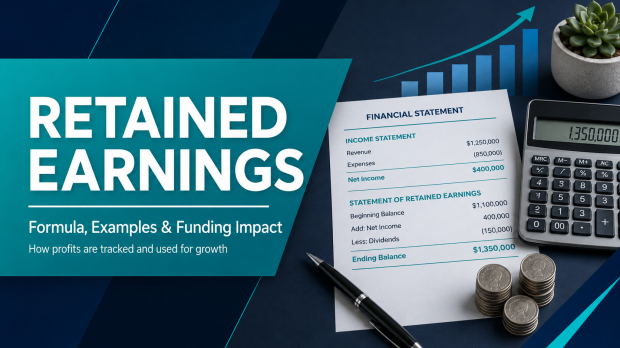
Business accounting guide •
What Are Retained Earnings and Why Do They Matter to Your Business?
Retained earnings are one of the most useful numbers on a company’s balance sheet because they show how much profit—or loss—the business has accumulated over time after accounting for dividends or applicable owner distributions. This guide explains what retained earnings are, the retained earnings formula, how they accumulate, what negative retained earnings mean, and how the trend can affect business funding decisions.
Reviewed against U.S. Securities and Exchange Commission and IRS educational resources: August 2026.
Reviewing your financials before applying for business funding?
Excel Capital helps established businesses compare funding options for working capital, payroll, materials, inventory, equipment and other operating needs.
Financing is subject to underwriting, approval, product availability and provider requirements.
What Are Retained Earnings?
Retained earnings are the cumulative profits a business has kept in the company instead of distributing them to owners or shareholders. They function like a running accounting balance. Each period’s profit or loss changes the balance, and eligible dividends or distributions reduce it.
Net income
Positive net income generally increases retained earnings.
Net losses
Losses generally reduce the accumulated retained earnings balance.
Distributions
Dividends and certain owner distributions can reduce retained earnings.
Carries forward
The ending balance becomes the starting point for the next accounting period.
This is what separates retained earnings from most numbers on an income statement. An income statement tells you how profitable a company was during a specific period. Retained earnings give historical context by carrying accumulated results forward.
For example, a business may earn $150,000 this year but have $850,000 of retained earnings because it has accumulated profits over several prior years. The SEC explains that shareholders’ equity reflects owners’ interests in the company and that companies may either distribute earnings or retain them. See the SEC’s Beginners’ Guide to Financial Statements.
If you want to see where retained earnings appear, Excel Capital’s balance sheet guide explains the basic asset, liability and equity structure.
Why Are Retained Earnings Important?
Retained earnings can reveal financial history that a single year of revenue or profit cannot. A company can have a strong current year while still carrying accumulated losses from earlier periods. Another company can have one weak year while maintaining a large positive retained earnings balance built during a decade of profitable operations.
| What You Are Evaluating | What Retained Earnings Can Help Show |
|---|---|
| Historical profitability | Whether profits or losses have accumulated over time. |
| Financial resilience | Whether the company has built equity through prior earnings. |
| Distribution policy | How much of past earnings has remained inside the company. |
| Growth and reinvestment | Whether earnings have been retained to support operations or expansion. |
| Shareholders’ equity | Retained earnings are commonly one component of total equity. |
| Funding analysis | The trend can add historical context to profitability, leverage and net worth. |
Important: retained earnings should never be analyzed alone. Current cash flow, liquidity, revenue, debt, profitability and the quality of the company’s assets all matter—especially in underwriting.
Retained Earnings Formula
The basic retained earnings formula is straightforward:
If the company has a net loss, subtract the loss rather than adding net income. Formal financial statements can also include prior-period or other equity adjustments.
How the Retained Earnings Formula Works
Remember: profit tends to push retained earnings up; losses and distributions tend to push the balance down.
How to Calculate Retained Earnings
If you are trying to learn how to calculate retained earnings, start with the prior period’s balance and then adjust it for the current period’s net income or loss and distributions.
Retained Earnings Example
Assume a business begins the year with $300,000 in retained earnings, generates $125,000 of net income and distributes $25,000.
That $400,000 generally becomes the beginning retained earnings balance for the next period. If you need to calculate the profit portion first, use Excel Capital’s net income formula guide or review how to prepare a profit and loss statement.
How Do Retained Earnings Accumulate Over Time?
Retained earnings are cumulative. They normally do not reset to zero just because a fiscal year ends. Each ending balance becomes the next period’s beginning balance, which means a profitable business can build a substantial retained earnings balance over time.
How Retained Earnings Can Build Year After Year
$100K profit − $20K distributions
$80K beginning + $150K profit − $30K distributions
$200K beginning + $200K profit − $40K distributions
$360K beginning + $250K profit − $50K distributions
Across four years, the company generated $700,000 in cumulative net income and distributed $140,000, leaving $560,000 of retained earnings.
What Is a Statement of Retained Earnings?
A statement of retained earnings explains how the retained earnings balance changed during an accounting period. It creates a bridge between current-period profitability and the ending equity balance shown on the balance sheet.
| ABC Construction LLC — Statement of Retained Earnings | |
|---|---|
| Beginning retained earnings | $300,000 |
| Add: Net income | +$125,000 |
| Less: Dividends/distributions | −$25,000 |
| Ending retained earnings | $400,000 |
Some companies issue a separate statement of retained earnings. Others show these changes in a broader statement of shareholders’ equity or statement of changes in equity. The SEC identifies the statement of shareholders’ equity as one of the primary financial statements used to show changes in owners’ interests over time.
How to Find Retained Earnings on a Balance Sheet
If you are wondering how to find retained earnings, start with the company’s balance sheet. Retained earnings are generally presented within the equity section, although the exact label can vary by entity and accounting presentation.
- Open the balance sheet.Choose the reporting date you want to examine—for example, December 31, 2026.
- Find the equity section.The core accounting equation is Assets = Liabilities + Equity.
- Look for retained earnings or accumulated deficit.Possible labels include retained earnings, accumulated earnings, retained deficit or accumulated deficit.
- Compare several periods.A three- or four-year trend is usually more informative than one isolated balance.
| Year | Example A: Improving | Example B: Deteriorating |
|---|---|---|
| 2023 | −$250,000 | $300,000 |
| 2024 | −$140,000 | $190,000 |
| 2025 | −$30,000 | $50,000 |
| 2026 | $125,000 | −$125,000 |
The same current-year balance can mean very different things depending on the direction of the trend. To understand the equity section more broadly, review Excel Capital’s guide to assets, liabilities and equity.
Retained Earnings vs. Net Income vs. Cash vs. Equity
These accounting terms are related, but they are not interchangeable.
| Financial Metric | What It Measures |
|---|---|
| Revenue | Total sales or income generated before expenses. |
| Net income | Profit or loss generated during a specific reporting period. |
| Retained earnings | Accumulated earnings kept in the business over time, adjusted for losses and distributions. |
| Cash | Money currently held in cash or bank accounts. |
| Total equity | The residual interest in assets after liabilities; retained earnings are commonly one component. |
Retained earnings are not cash. A company with $2 million of retained earnings does not necessarily have $2 million sitting in a bank account. Prior profits may have been reinvested into inventory, equipment, accounts receivable, real estate, technology, debt reduction or expansion.
This distinction matters in financing. The SEC notes that a balance sheet is a snapshot of assets, liabilities and equity, while a cash-flow statement tracks actual cash inflows and outflows. A profitable company can therefore have strong retained earnings but still experience a cash-flow shortage.
What Do Negative Retained Earnings Mean?
When retained earnings fall below zero, the company generally has an accumulated deficit. This means cumulative losses and distributions have exceeded accumulated profits.
The company ends the period with a $100,000 accumulated deficit.
What Can Cause Negative Retained Earnings?
- Repeated operating losses: losses accumulate faster than profits.
- A large one-time loss: litigation, impairment, restructuring, inventory write-offs or a failed expansion can materially reduce earnings.
- Large distributions: a profitable business can retain relatively little if it distributes most earnings.
- Early-stage growth: some young companies operate at intentional losses while investing heavily in expansion.
- Accounting or restructuring events: certain transactions and adjustments can affect equity balances.
Negative RE + Deteriorating
- Retained earnings: −$500K
- Current-year loss: −$250K
- Revenue declining
- Cash balances falling
- Existing debt increasing
Negative RE + Improving
- Retained earnings: −$500K
- Current-year income: +$275K
- Revenue growing
- Cash balances rising
- Existing debt decreasing
Negative retained earnings are a signal to investigate, not an automatic conclusion that a business is failing. The reason for the deficit, current profitability and the direction of the trend all matter.
How Retained Earnings Affect Business Funding Decisions
Retained earnings can matter when a company applies for a small business loan, business line of credit, term loan or another financing product. They are rarely the only factor. Instead, the balance and its trend provide historical context for the company’s overall financial condition.
Where Retained Earnings Fit in Underwriting
Key point: strong retained earnings can support the financial picture, but they do not replace strong current cash flow and repayment capacity.
How Positive Retained Earnings Can Strengthen the Financial Picture
- More equity: retained earnings commonly increase shareholders’ equity when other factors are unchanged.
- Historical profitability: a growing balance can complement current income statements and tax returns.
- Potentially stronger leverage ratios: greater equity can improve some debt-to-equity measurements.
- Evidence of reinvestment: profits kept in the business may have funded inventory, equipment, expansion or working capital.
The SEC’s financial statement guide gives the basic debt-to-equity formula as Total Liabilities ÷ Shareholders’ Equity. Since retained earnings are commonly part of equity, accumulated profits can influence this ratio. Underwriters may also review repayment-focused measures such as the debt-service coverage ratio (DSCR).
How Negative Retained Earnings Can Affect an Application
A negative balance does not automatically mean a company cannot obtain financing, but it can create additional questions:
- Why did retained earnings become negative?
- Is the accumulated deficit getting better or worse?
- Is the business currently profitable?
- Does the company have adequate liquidity?
- How much existing debt is already being serviced?
- Can operating cash flow comfortably support another obligation?
Funding takeaway: a company with positive retained earnings can still have weak cash flow, and a company with negative retained earnings can be in the middle of a meaningful turnaround. Underwriting should evaluate the full set of financial statements and current operating data.
Example: Same Revenue, Very Different Funding Profiles
Two companies can report the same annual sales and still look dramatically different once profitability, retained earnings, cash and debt are considered.
| Metric | Company A | Company B |
|---|---|---|
| Annual revenue | $5,000,000 | $5,000,000 |
| Net income | $500,000 | $75,000 |
| Retained earnings | $1,250,000 | −$450,000 |
| Cash | $600,000 | $90,000 |
| Existing debt | $750,000 | $1,900,000 |
| Total equity | $1,500,000 | $100,000 |
Revenue alone would not reveal these differences. Company A has accumulated profits, greater liquidity and less debt in this simplified example. Company B generates the same sales but has less profit, an accumulated deficit and substantially higher leverage. This illustrates why underwriters rarely make a funding decision from revenue alone.
Retained Earnings and Different Types of Business Funding
Bank and SBA Financing
Traditional bank and SBA-related financing commonly involves detailed financial review. Balance sheets, profit and loss statements, tax returns, debt schedules and cash-flow information may all be relevant. Retained earnings therefore fit into a larger analysis of equity, profitability and repayment ability.
Business Term Loans
Term-loan underwriting can evaluate current profitability, operating history, existing debt, credit and cash flow alongside the balance sheet. See Excel Capital’s business term loan guide for an overview of how term financing works.
Business Lines of Credit
A business line of credit is revolving financing, so cash flow and the ability to support recurring draws and repayments can be particularly important.
Alternative Business Financing
Some alternative funding providers place greater emphasis on current revenue, business bank activity, deposit consistency, time in business and repayment performance than traditional banks do. Retained earnings can still be useful because they provide historical financial context behind that current activity.
How Can a Business Increase Retained Earnings?
Because retained earnings ultimately come from profits kept in the company, there are two broad levers: generate more profit and retain more of those profits.
Improve gross margin
Review pricing, supplier costs, product mix and direct labor efficiency.
Control expenses
Reduce unnecessary overhead without undermining productive capacity.
Improve collections
Faster receivable collection can strengthen cash flow even when book profit is unchanged.
Balance distributions
Consider current owner distributions against the company’s future capital needs.
Retained Earnings and Accounts Receivable
Retained earnings can increase even when the corresponding cash has not yet been collected. For example, under accrual accounting, a profitable credit sale can increase net income while the cash remains in accounts receivable. This is another reason profitability and retained earnings should not be confused with liquidity.
Businesses that invoice customers should review receivable aging and collection performance alongside retained earnings and net income. That provides a more complete picture of whether reported earnings are turning into cash.
Retained Earnings vs. Owner’s Equity
Retained earnings are generally part of equity, not the entire equity balance. Depending on the entity, equity may include common stock, member or owner capital, additional paid-in capital, treasury stock and other equity accounts.
Or, viewed another way: Equity = Assets − Liabilities.
Do LLCs Have Retained Earnings?
The terminology can vary by legal structure, tax classification and accounting presentation. Corporations commonly use the term retained earnings. Some LLCs, partnerships and sole proprietorships may instead present accumulated ownership amounts through accounts such as members’ equity, partners’ capital or owner’s equity. An accountant can clarify the correct presentation for a particular entity.
Retained Earnings and Taxes: An Important Distinction
Book retained earnings are not automatically identical to the federal tax concept of earnings and profits (E&P). Tax accounting rules can differ from financial accounting rules. IRS Publication 542 explains that corporations can accumulate earnings for expansion and other bona fide business reasons, while certain accumulations beyond the reasonable needs of the business may be subject to accumulated earnings tax.
External reference: IRS Publication 542 — Corporations. Tax treatment depends on the facts and entity structure, so business owners should consult a qualified tax professional.
Common Retained Earnings Mistakes
- Thinking retained earnings equal cash. They are an equity account, not a bank balance.
- Looking at only one year. Retained earnings are cumulative; the trend matters.
- Confusing revenue with retained earnings. Revenue is sales before expenses; retained earnings reflect accumulated net results after distributions.
- Assuming negative retained earnings mean automatic failure. A company may be improving from prior losses.
- Assuming positive retained earnings guarantee financial strength. Liquidity and debt can still be weak.
- Ignoring distributions. A profitable company may distribute much of its earnings rather than retain them.
- Ignoring the rest of the balance sheet. Cash, receivables, liabilities, debt and total equity provide necessary context.
Frequently Asked Questions About Retained Earnings
What are retained earnings?
Retained earnings are cumulative earnings a business has kept rather than distributed to owners or shareholders, adjusted for losses and applicable distributions.
What is the retained earnings formula?
The basic formula is Beginning Retained Earnings + Net Income − Dividends/Distributions = Ending Retained Earnings.
How do you calculate retained earnings?
Start with the previous period’s retained earnings balance, add current-period net income or subtract a net loss, and subtract dividends or applicable distributions.
Where are retained earnings on the balance sheet?
Retained earnings are generally found in the shareholders’ equity, owner’s equity or related equity section of the balance sheet.
What is a statement of retained earnings?
It is a financial statement or schedule explaining the change from beginning retained earnings to ending retained earnings during a reporting period.
Are retained earnings an asset?
No. Retained earnings are generally part of equity. Cash, inventory, equipment and accounts receivable are examples of assets.
Are retained earnings the same as cash?
No. Retained profits may already have been invested in inventory, equipment, receivables, real estate, debt reduction or other business assets.
Can retained earnings be negative?
Yes. A negative balance is generally referred to as an accumulated deficit and can result when cumulative losses and distributions exceed accumulated profits.
Do retained earnings reset every year?
Normally, no. The ending retained earnings balance generally carries forward into the next accounting period.
Can a business have high retained earnings but low cash?
Yes. Retained earnings measure accumulated accounting profits kept in the business, not the current bank balance.
How do retained earnings affect a business loan?
They can add context about accumulated profitability and equity, but financing decisions may also consider current cash flow, revenue, liquidity, existing debt, credit, profitability, collateral and time in business.
Can you get business funding with negative retained earnings?
Potentially. A negative balance is not always an automatic decline. The reason for the deficit, current performance, cash flow, debt load and whether the trend is improving can all matter.
Retained Earnings: The Bottom Line
Retained earnings are more than another line on a balance sheet. They show part of the financial history of a business: how profits and losses have accumulated and how much has remained in the company after distributions.
The formula is simple—Beginning Retained Earnings + Net Income − Dividends/Distributions = Ending Retained Earnings—but the interpretation requires context. Positive retained earnings do not guarantee strong liquidity, and negative retained earnings do not automatically mean a business is failing.
For funding decisions, retained earnings are most useful when viewed alongside current profitability, cash flow, liquidity, existing debt, revenue trends and repayment capacity.
See what your business may qualify for
If you are reviewing your balance sheet because you are preparing for financing, Excel Capital can help you compare business funding options based on your current needs and financial profile.
Financing is subject to underwriting, approval, product availability and provider requirements. This article is for educational purposes and is not accounting, tax, legal or financial advice.

