Compare funding products tailored to your business.
Fast & secure
No impact on credit*
Multiple funding products
Submitting your application does not require a hard credit inquiry. Some traditional banks may require one before funding. We’ll notify you before any hard inquiry is made.
Where Ambition Meets Excellence
Corporate tax guide •
Form 1120, U.S. Corporation Income Tax Return, is the federal income tax return that domestic C corporations generally file. Other eligible entities use it when they elect to be taxed as corporations. On the 1120 tax form, businesses report gross income, deductions, credits, taxable income, total tax, and payments, then determine any amount owed or overpayment.
Reviewed against the final 2025 Form 1120 and IRS instructions, plus the early-release 2026 draft. This educational guide does not replace the form instructions or advice from a qualified tax professional.
Quick answer: What is Form 1120? It is the primary federal income tax return for a C corporation. Domestic corporations generally file it even when they have no taxable income, unless they are exempt or required to use a special return. By contrast, a business with a valid S election generally files Form 1120-S instead and reports each shareholder’s share on Schedule K-1 (Form 1120-S).
✓
Use the final form for the applicable tax year. As of August 23, 2026, the IRS lists the final 2025 Form 1120 and 2025 instructions as the current materials. The posted 2026 form is an early-release draft marked Draft: Do Not File.
Explore business funding options for payroll, inventory, equipment, materials, or other operating expenses while you address tax obligations with your accountant or tax attorney.
Financing is subject to approval, provider requirements, and permitted use-of-proceeds terms. Excel Capital does not provide tax or legal advice.
What Is Form 1120?
Form 1120 is the U.S. Corporation Income Tax Return. A corporation uses the form to calculate federal taxable income and income tax, claim applicable deductions and credits, report estimated payments and other credits, and determine whether it owes additional tax or has an overpayment.
Page 1 summarizes the main tax calculation, while the supporting schedules explain the figures behind it. They cover dividends, tax computation, accounting methods, owners and related entities, balance sheets, retained earnings, and differences between financial-statement income and taxable income.
C
Primary users
Domestic C corporations and eligible entities that elect federal corporate classification.
$
What it calculates
Taxable income, corporate tax, credits, payments, balance due, and overpayment.
15
General deadline
The 15th day of the fourth month after year-end, with a special rule for June 30 year-ends.
10
E-file threshold
Mandatory e-filing generally applies when the corporation files 10 or more returns of any type in the calendar year.
Form 1120 is the federal income tax return generally associated with C corporations.
Form 1120 vs. Form 1120-S vs. Schedule K-1
Before filing, check which return matches your business’s tax classification. These forms have similar names but serve different purposes. The regular 1120 form is generally a C corporation return. Form 1120-S is the return for a corporation with a valid S election. Schedule K-1 (Form 1120-S) reports each shareholder’s allocated share of S corporation tax items.
Form or schedule
Who uses it
What it reports
Key distinction
Form 1120
C corporations and eligible entities taxed as corporations
Corporate income, deductions, credits, tax, payments, and supporting information
The corporation generally pays federal income tax at the entity level.
Form 1120-S
Corporations with a valid S election
S corporation income, deductions, credits, shareholder allocations, and certain entity-level taxes
Most tax items generally pass through to shareholders.
Schedule K (Form 1120)
A corporation filing regular Form 1120
Accounting method, ownership, foreign reporting, distributions, information-return questions, and other facts
It is titled Other Information; it is not a shareholder allocation schedule.
Schedule K-1 (Form 1120-S)
An S corporation for each shareholder
Each shareholder’s share of income, deductions, credits, and other items
A regular C corporation Form 1120 does not issue shareholder K-1s.
Keep these schedules separate: Form 1120 Schedule K and Schedule K-1 serve different purposes. The regular corporate return includes Schedule K for informational questions. With Form 1120-S, Schedule K-1 reports each shareholder’s share of tax items.
Unless it is exempt under Internal Revenue Code section 501 or required to file a special return, a domestic corporation generally must file Form 1120 whether or not it has taxable income. An eligible business entity, including an LLC, can also become a Form 1120 filer after electing corporate classification for federal tax purposes, generally on Form 8832.
Business Return Selector
Use this guide to identify the likely return for your business. Then check the filing rules: tax elections, ownership, foreign activity, and certain industries can change which return is required.
How is the business classified for federal tax purposes?
↓
C corporation
File Form 1120
This generally includes a corporation that has not elected S status and an eligible entity that elected corporate classification.
S corporation
File Form 1120-S
A valid S election generally leads to Form 1120-S plus a Schedule K-1 for each shareholder.
Partnership / default multi-member LLC
Usually file Form 1065
The partnership generally provides Schedule K-1 to its partners.
Sole proprietor / default single-member LLC
Usually report on Form 1040
Business income and deductions are commonly reported on individual Schedule C, not Form 1120 Schedule C.
LLC reminder: “LLC” describes how a business is organized under state law. It does not, by itself, tell you which federal tax return to file. LLC tax classification depends on the number of owners and elections made. Depending on those facts, an LLC may be treated as a disregarded entity, partnership, C corporation, or S corporation.
For help with the sole-proprietor schedule (rather than the corporate dividend schedule), see Excel Capital’s Schedule C instructions.
What to Gather Before Filling Out Form 1120
Gather your books and supporting tax records before you begin. With a complete set in front of you, it is easier to prepare the corporate tax return and catch mismatches between page 1, attached forms, Schedule L, and the book-to-tax reconciliation.
Entity and filing information
Legal name, address, and EIN
Date incorporated and tax year
Initial, final, name-change, or address-change status
Prior-year return and carryforward schedules
Financial statements
Year-end trial balance
Profit and loss statement
Beginning and ending balance sheets
General ledger detail for unusual or material accounts
Income and deduction support
Sales, returns, allowances, and cost of goods sold
Payroll and officer compensation
Fixed-asset and depreciation schedules
Interest, taxes, contributions, benefits, and other deductions
Ownership and special reporting
Shareholder and related-entity information
Foreign ownership or foreign activity
Forms 1099 and other information-return obligations
Estimated tax payments, extension deposits, and credits
How to Fill Out Form 1120: Step-by-Step Instructions
Start with the final IRS form for the correct tax year. Page 1 summarizes the income, deductions, taxable income, tax, payments, and refund or balance due. Use the remaining pages and attached schedules to work through the calculations and supply the details behind those totals.
This Form 1120 example shows how the main sections of the corporate return fit together.
Edition note: The screenshots on this page show an earlier edition of Form 1120. Use them to get familiar with the layout, keeping in mind that line numbers and fields can change. Prepare the return using the final IRS form and instructions for the applicable tax year.
1
Select the correct form year and return typeConfirm the corporation is a Form 1120 filer, not a Form 1120-S, Form 1065, or other special-return filer.
2
Complete the identifying informationEnter the legal name, address, EIN, date incorporated, total assets, tax year, and applicable checkboxes.
3
Report income on lines 1 through 11Reconcile sales, cost of goods sold, dividends, interest, rents, gains, and other income to the books and attachments.
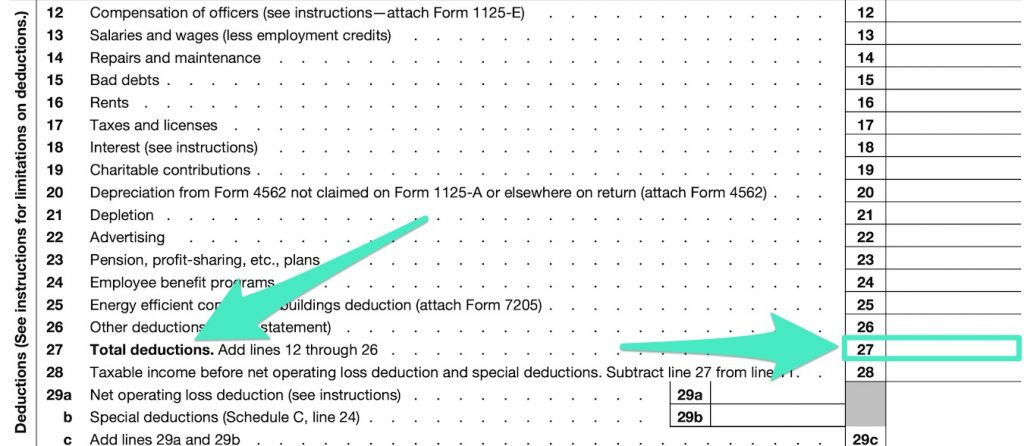
4
Report deductions on lines 12 through 27Classify deductions correctly and attach supporting forms or statements where the form requires them.
5
Calculate taxable income on lines 28 through 30Account for the net operating loss deduction and Schedule C special deductions when applicable.
6
Complete Schedule J and the payment sectionCalculate total tax and credits, reconcile deposits and payments, and determine the balance due or overpayment.
7
Complete all applicable schedules and attachmentsReview Schedules C, K, L, M-1, M-2, M-3, and every question that may trigger another form.
8
Review, sign, and fileAn authorized officer signs the return. The paid preparer section is completed only by a paid preparer.
Step 1: Complete the Corporation’s Identifying Information
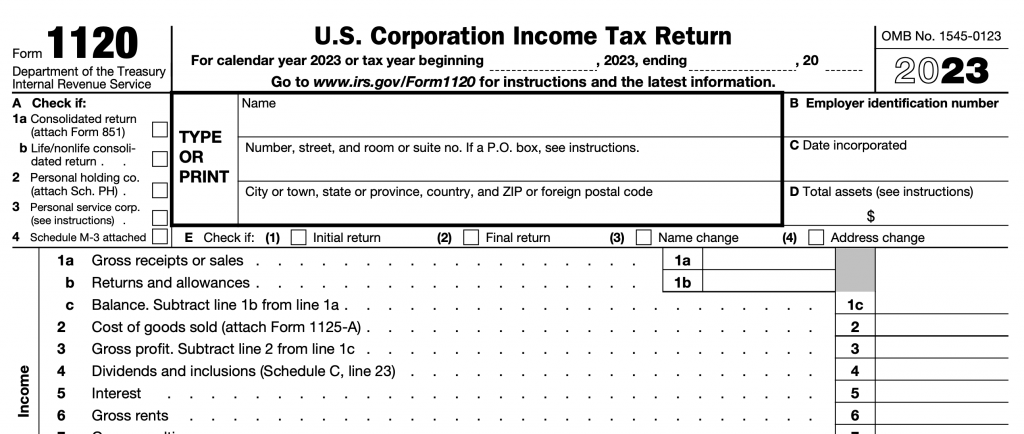
Enter the corporation’s legal name and mailing address exactly as they should appear in IRS records. Include the EIN, incorporation date, and total assets at year-end. Check the appropriate boxes for a consolidated return, personal holding company, personal service corporation, Schedule M-3 attachment, initial return, final return, name change, or address change.
The top of Form 1120 identifies the corporation, tax year, filing status, and total assets.
Use the corporation’s tax year. A calendar-year return covers January 1 through December 31. For a fiscal-year corporation, report the beginning and ending dates shown on the form. Learn more in Excel Capital’s guide to what a fiscal year is.
Step 2: Report Income on Lines 1 Through 11
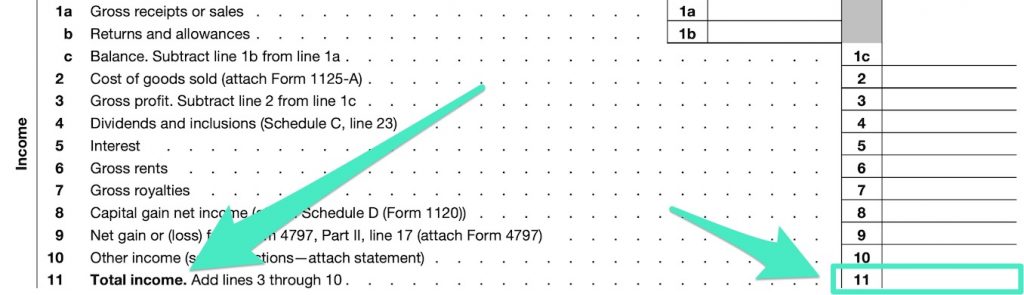
Report gross receipts or sales on line 1a, returns and allowances on line 1b, and net sales on line 1c. If the corporation sells products, it generally reports cost of goods sold on line 2 and attaches Form 1125-A. From there, the return calculates gross profit and adds the other categories of income.
2025 line
Income category
Preparation note
1a–3
Gross receipts, returns and allowances, cost of goods sold, and gross profit
Reconcile sales to the general ledger and Form 1125-A when inventory or production costs apply.
4
Dividends and inclusions
Enter the amount from Form 1120 Schedule C, line 23 (the corporate schedule, not the individual Schedule C for sole proprietors).
5–7
Interest, gross rents, and gross royalties
Report gross income in the proper category and separately classify related deductions.
8
Capital gain net income
Attach Schedule D (Form 1120) when required.
9
Net gain or loss from Form 4797
Use the line reference shown on the current-year Form 1120 and attach Form 4797.
10–11
Other income and total income
Attach a supporting statement for line 10 and verify that line 11 includes every applicable category.
The income section combines operating revenue with dividends, interest, rents, royalties, gains, and other income.
Step 3: Report Deductions on Lines 12 Through 27
The deduction section includes officer compensation, salaries and wages, repairs, bad debts, rents, taxes and licenses, interest, charitable contributions, depreciation, advertising, retirement-plan costs, employee benefits, the energy-efficient commercial buildings deduction, and other deductions.
Check whether an expense has its own line before putting it on line 26. Use that specific line, apply the limits in the instructions, and attach any required form or statement. For example, line 20 generally reports depreciation from Form 4562 that was not claimed on Form 1125-A or elsewhere on the return.
Classify deductions on the proper lines and retain records supporting business purpose, amount, timing, and applicable limitations.
Officer compensation deserves a separate review. Report officer compensation on line 12, separately from salaries and wages on line 13. You may also need Form 1125-E. Keep records supporting the compensation and make sure it is reasonable under the applicable tax rules.
Step 4: Calculate Taxable Income on Lines 28 Through 30
Subtract total deductions from total income to determine taxable income before the net operating loss deduction and special deductions. Enter an allowable net operating loss deduction on line 29a and the Schedule C special deductions on line 29b. Report the resulting taxable income on line 30.
Step 5: Complete Schedule J and Reconcile Tax, Credits, and Payments
Schedule J is the Tax Computation and Payment schedule. For Form 1120, Schedule J covers corporate tax rather than farming or fishing income averaging. Use it to calculate regular corporate income tax and other applicable taxes, subtract allowable credits, and reconcile estimated payments, extension deposits, withholding, refundable credits, and other amounts.
For the final 2025 form, page 1 carries total tax from Schedule J to line 31. New section 1062 farmland installment fields appear on line 32 and Schedule J. Payments and credits flow to line 33, followed by the estimated-tax penalty, amount owed, overpayment, credit to next year’s estimated tax, and refund information.
The tax and payment section determines whether the corporation owes tax or has an overpayment. The current final form also contains direct-deposit fields for a refund.
Step 6: Sign the Return and Complete the Paid Preparer Section
An authorized corporate officer signs and dates the return and enters the officer’s title. In addition, the corporation can indicate whether the IRS may discuss the return with the paid preparer shown below the signature area. An employee or other unpaid preparer generally leaves the paid preparer section blank. If you use a paid preparer, that person completes the name, signature, date, PTIN, firm information, and applicable checkbox.
The return is not complete until it is signed by an authorized officer and the paid preparer section is completed when applicable.
Key Form 1120 Schedules Explained
The supporting schedules organize the details behind the return. Schedule C reports dividends and inclusions, while Schedule J calculates tax and payments. For other information and balance sheets, use Schedule K and Schedule L, respectively. Schedules M-1 and M-2 cover book income reconciliation and retained earnings. Larger corporations and other required filers use Schedule M-3 to replace or supplement the book-to-tax reconciliation.
Form 1120 Schedule Map
Follow the information from the corporation’s books to page 1, then through tax computation, informational questions, balance sheets, and book-to-tax reconciliation.
C
Dividends & inclusions
Carries dividends and inclusions to page 1, line 4, and special deductions to line 29b.
J
Tax computation & payment
Calculates total tax, credits, payments, and amounts that flow back to page 1.
K
Other information
Covers accounting method, business activity, ownership, foreign reporting, distributions, and compliance questions.
L
Balance sheets per books
Reports beginning and ending assets, liabilities, and shareholders’ equity from the corporation’s books.
M-1
Book-to-tax reconciliation
Explains differences between book income and income reported on the return.
M-2
Retained earnings analysis
Reconciles unappropriated retained earnings from the beginning to the end of the year.
M-3
Detailed book-to-tax reporting
Generally required when total assets are $10 million or more, subject to the instructions.
B
Additional M-3 information
Schedule B (Form 1120) is an additional information schedule for corporations required to file Schedule M-3.
K-1
Not part of regular Form 1120
Shareholder K-1 reporting belongs to Form 1120-S, not the C corporation Form 1120.
Schedule C: Dividends, Inclusions, and Special Deductions
Use Form 1120 Schedule C to report dividends and certain inclusions, apply the required percentages for special deductions, and carry the totals to page 1. On the final 2025 return, Schedule C line 23 flows to page 1, line 4, while Schedule C line 24 flows to page 1, line 29b.
Do not confuse two different Schedule C forms. Form 1120 Schedule C concerns corporate dividends, inclusions, and special deductions. Individual Schedule C (Form 1040) reports profit or loss from a sole proprietorship.
Schedule J: Tax Computation and Payment
On Schedule J, calculate corporate income tax and other applicable taxes, subtract credits, add certain recapture taxes or interest, and summarize payments and refundable credits. Amounts from supporting forms, including Forms 1118, 3800, 4626, 8827, and 8991, can affect the final tax calculation on this schedule.
Schedule K: Other Information
The questions on Schedule K cover the accounting method, principal business activity, ownership and related entities, foreign ownership, tax-exempt interest, and shareholder count. They also address net operating loss information, distributions, uncertain tax positions, Forms 1099, reportable transactions, digital assets, interest-limitation thresholds, and other compliance matters. Work through every question that applies to the corporation, because a “Yes” answer may require another schedule, form, statement, or election.
Schedule L: Balance Sheets per Books
Use Schedule L to report beginning and ending assets, liabilities, and shareholders’ equity. These balance sheets should agree with the corporation’s books and records. Check that retained earnings and current-year activity also agree with Schedule M-2 and the financial statements, with any differences properly reconciled. Our balance sheet guide explains how assets, liabilities, and shareholders’ equity fit together.
Small-corporation exception: On the 2025 form, a corporation is generally not required to complete Schedules L, M-1, and M-2 when both total receipts for the year and total assets at year-end are less than $250,000 and Schedule K, question 13, is answered “Yes.” This is different from the $10 million Schedule M-3 threshold.
Schedules M-1, M-2, and M-3
Schedule
Purpose
Common items
Threshold or caution
M-1
Reconciles income per books with income per return
Federal income tax expense, book-tax depreciation differences, nondeductible expenses, tax-exempt income, and income timing differences
May be omitted under the small-corporation exception; a required M-3 filer generally follows the M-3 rules instead.
M-2
Analyzes unappropriated retained earnings
Beginning balance, net income per books, distributions, other increases or decreases, and ending balance. For help with the underlying accounting calculation, review the retained earnings formula and examples.
Should be consistent with Schedule L retained earnings and the corporation’s records.
M-3
Provides a more detailed book-to-tax reconciliation
Financial-statement income, temporary differences, permanent differences, and tax-return amounts
Generally required when total assets are $10 million or more; detailed completion options vary with filer size and the instructions.
Schedule B and Other Common Attachments
Schedule B (Form 1120) provides additional information for corporations required to file Schedule M-3. In addition, the corporation’s transactions, ownership, industry, and tax positions may require other schedules.
Schedule
General purpose
When it may matter
Schedule D (Form 1120)
Capital gains and losses
The corporation sold capital assets or has reportable capital gain or loss activity.
Schedule G (Form 1120)
Certain ownership information
Schedule K ownership questions identify reportable 20% or 50% ownership interests.
Schedule H (Form 1120)
Section 280H deduction limitations
A personal service corporation with an applicable non-calendar tax year may need the calculation.
Schedule N (Form 1120)
Foreign operations
The corporation has specified foreign operations, ownership, or reporting obligations.
Schedule O (Form 1120)
Consent plan and apportionment schedule for a controlled group
Members of a controlled group apportion certain tax benefits.
Schedule PH (Form 1120)
Personal holding company tax
The corporation meets the personal holding company rules.
Schedule UTP (Form 1120)
Uncertain tax positions
Specified corporations meet the asset and financial-statement conditions in the current instructions.
Recent IRS Updates to Form 1120
The final 2025 Form 1120 is the current edition listed by the IRS as of August 23, 2026. If your corporation must file a return in 2026, review these changes before you complete the form.
2025 final form
Direct-deposit refund fields
Page 1 now includes routing number, account type, and account number fields for a refund requested on line 37b. Confirm the account information carefully.
Penalty update
$525 late-filing minimum
For returns required to be filed in 2026, the minimum failure-to-file penalty for a return more than 60 days late increased to the smaller of the tax due or $525.
Research costs
New domestic R&E rules
New section 174A generally permits a current deduction for qualifying domestic research or experimental expenditures for tax years beginning after December 31, 2024, with capitalization and transition options described in the instructions.
Farmland election
New section 1062 lines
The final 2025 return adds fields for the qualified farmland installment election, including page 1 line 32 and related Schedule J entries. Specialized eligibility and payment rules apply.
CAMT
Estimated-tax penalty relief
The IRS instructions note continued relief from the addition to tax for underpayment of 2025 estimated income tax attributable to the corporate alternative minimum tax.
Draft only
2026 form is not fileable
The IRS has posted an early-release 2026 draft marked “Draft: Do Not File.” Although it expands the return and includes draft changes to lines and thresholds, businesses should wait for the final applicable form before filing.
Do not prepare a filed return from a draft. Draft forms are useful for planning but can change before release. Verify the revision year in the upper-right corner of the form and check the IRS Form 1120 page for later developments.
Form 1120 Deadline and Extension Rules
Form 1120 is generally due on the 15th day of the fourth month after the corporation’s tax year ends. A corporation with a fiscal year ending June 30 generally files by the 15th day of the third month after year-end. When the due date falls on a Saturday, Sunday, or legal holiday, the deadline generally moves to the next business day.
CY
Calendar-year corporation
For a corporation with a December 31 year-end, the filing deadline is generally April 15.
FY
June 30 fiscal year
For a June 30 fiscal year-end, the special rule generally makes the filing deadline September 15.
E
Automatic extension request
File Form 7004 by the regular due date when an extension is needed.
A timely Form 7004 extension generally extends the time to file. It does not extend the time to pay. Estimate the tax and pay by the original due date to reduce interest and penalties.
Form 1120 E-Filing and Payment Requirements
Mandatory e-filing generally applies to Form 1120 when the corporation is required to file 10 or more returns of any type during the calendar year. The count can include income tax returns, employment tax returns, excise tax returns, and information returns. However, the IRS may waive the e-file requirement when electronic filing would cause undue hardship.
File electronically through an authorized provider or compatible tax software. Keep the signed authorization and supporting records, and follow the IRS electronic-payment instructions for corporate taxes. On the final 2025 form, refund direct-deposit fields appear on page 1, but payment methods and deposit rules still depend on the applicable IRS instructions.
Do not rely on an old “250-return” e-file rule. The current general threshold is 10 returns of any type during the calendar year, subject to the applicable regulations and waiver rules.
Common Form 1120 Mistakes to Avoid
1
Using the wrong corporate returnConfirm whether the entity is a C corporation, S corporation, partnership, disregarded entity, exempt organization, or special-return filer.
2
Confusing Schedule C, Schedule J, Schedule K, and Schedule K-1On Form 1120, Schedule C covers dividends, Schedule J computes tax, and Schedule K collects other information. K-1 belongs to Form 1120-S or Form 1065.
3
Using a prior-year form without checking line changesTreat the screenshots as examples only. Download the final form for the correct tax year before you prepare the return.
4
Failing to reconcile Schedule L and Schedule MBalance sheets, retained earnings, book income, and page 1 amounts should be consistent with the corporation’s records and explanations.
5
Missing a triggered attachmentReview every Schedule K answer and each page 1 line that calls for a form, schedule, election statement, or supporting detail.
6
Treating an extension as extra time to payForm 7004 extends filing time, not payment time. Estimate and pay by the original due date.
7
Omitting a signature or paid preparer informationAn authorized officer must sign, and a paid preparer must complete the preparer section.
8
Overlooking the 10-return e-file thresholdCount all return types the corporation must file during the calendar year, not only income tax returns.
Form 1120 Frequently Asked Questions
Form 1120 Basics
What is Form 1120?
Form 1120, U.S. Corporation Income Tax Return, is the federal return generally used by domestic C corporations and other eligible entities that elect corporate tax treatment. Businesses use it to report income, deductions, credits, taxable income, tax liability, and payments, then determine any refund or balance due.
What is an 1120 tax form used for?
Businesses use the 1120 tax form to calculate corporate income tax at the federal level. The return also supplies details about accounting methods, ownership, related entities, assets, book-to-tax differences, credits, and other filing obligations.
Who must file Form 1120?
Domestic corporations generally must file Form 1120 even when they have no taxable income, unless they are exempt under the Internal Revenue Code or must use a special return. For an LLC, filing Form 1120 generally follows an election to be classified as a corporation for federal tax purposes.
Is Form 1120 the same as Form 1120-S?
No. A C corporation generally uses Form 1120 for its federal income tax return. With a valid S election, the business generally files Form 1120-S instead. Most tax items then generally pass through to shareholders, with their shares reported on Schedule K-1.
Does a regular Form 1120 include Schedule K-1?
No. A C corporation filing a regular Form 1120 does not issue shareholder Schedule K-1 forms. You will commonly encounter Schedule K-1 with Form 1120-S and Form 1065 instead. The regular corporate return includes Schedule K, which is an Other Information questionnaire.
Form 1120 Schedules and Reporting Requirements
What is Schedule B on Form 1120?
Corporations required to file Schedule M-3 use Schedule B (Form 1120) to provide additional information. That requirement does not apply to every corporation filing Form 1120.
What is Schedule K on Form 1120?
Titled Other Information, Schedule K asks about the corporation’s accounting method, business activity, and ownership. It also covers foreign reporting, distributions, Forms 1099, digital assets, gross receipts, and other filing matters.
When can a corporation omit Schedules L, M-1, and M-2?
On the 2025 form, a corporation can generally omit Schedules L, M-1, and M-2 when both its total receipts for the tax year and its total assets at year-end are less than $250,000 and it answers Yes to Schedule K, question 13. Before relying on this exception, review the instructions for the tax year being filed.
What is the difference between Schedules M-1, M-2, and M-3?
Use Schedule M-1 to reconcile income on the corporation’s books with income reported on the tax return. Changes in unappropriated retained earnings during the year belong on Schedule M-2. For a more detailed book-to-tax reconciliation, Schedule M-3 generally applies when total assets are $10 million or more, subject to the current IRS instructions.
Form 1120 Deadlines, E-Filing, and LLC Rules
When is Form 1120 due?
Form 1120 is generally due on the 15th day of the fourth month after the corporation’s tax year ends. However, a corporation with a June 30 fiscal year generally uses the 15th day of the third month after year-end. When a deadline falls on a weekend or legal holiday, it generally moves to the next business day.
Does Form 7004 extend the time to pay corporate tax?
No. Filing Form 7004 generally gives you more time to file the corporate tax return, but the payment deadline stays the same. Estimate and pay the corporation’s tax by the original Form 1120 due date to help reduce potential interest and penalties.
Must Form 1120 be filed electronically?
If the corporation is required to file 10 or more returns of any type during the calendar year, it generally must e-file Form 1120. However, the IRS may waive this requirement when electronic filing would cause undue hardship.
Can an LLC file Form 1120?
Yes, but generally only when the LLC has elected to be treated as a corporation for federal tax purposes, commonly by filing Form 8832. By comparison, a default-classified multi-member LLC generally files Form 1065, while a default single-member LLC is usually disregarded for federal income tax purposes.
Which Form 1120 should a corporation use in 2026?
Use the final Form 1120 and instructions for the tax year you are filing. As of the article’s latest IRS review, the final 2025 form and 2025 instructions are the current filing materials. The IRS has also published an early-release 2026 draft marked Draft: Do Not File, which businesses should not use to prepare a filed return.
Keep Your Business Moving While Managing Tax Obligations
A tax payment can put pressure on the cash you need for payroll, inventory, materials, equipment, and day-to-day operations. Excel Capital helps established businesses compare financing options based on their qualifications and intended use of funds.
Excel Capital Management is not a tax preparation firm, accounting firm, or law firm. This article is general educational information and is not tax, legal, or accounting advice. Financing is subject to approval and provider terms.
Official sources reviewed: IRS Form 1120 (2025); Instructions for Form 1120 (2025); IRS About Form 1120; IRS About Form 1120-S; IRS Schedule K-1 resources; and the early-release 2026 draft Form 1120. Always verify the final form, instructions, and later IRS developments for the corporation’s tax year.