

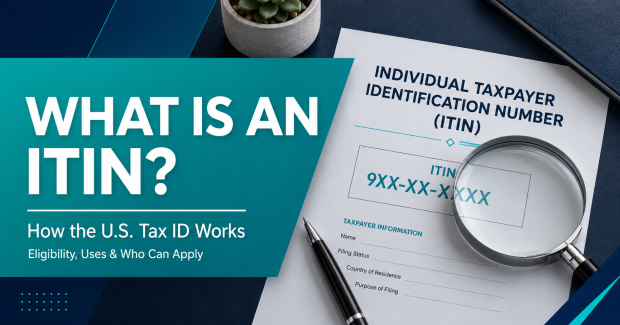
Individual taxpayer identification number guide •
An Individual Taxpayer Identification Number, or ITIN, is a nine-digit tax-processing number issued by the Internal Revenue Service. It is for someone who needs a U.S. taxpayer identification number for a federal tax purpose but does not have a Social Security number and is not eligible to receive one.
Reviewed against current IRS ITIN guidance, IRS Topic No. 857, the December 2024 Instructions for Form W-7, and current Social Security Administration guidance. This article is educational and is not tax, immigration, or legal advice.
What Is an ITIN Number?
ITIN stands for Individual Taxpayer Identification Number. The IRS uses this number to identify an individual in the federal tax system when that person is not eligible for a Social Security number. Although people commonly say “ITIN number,” the word “number” is already included in the acronym.
Each ITIN belongs to an individual, not a company, and stays connected to that person’s federal tax record. The number has nine digits, begins with a 9, and uses the same general hyphenated format as an SSN. The sample format below is not a valid tax number.
Illustrative format: 9XX-XX-XXXX. This explains the structure only and does not display a real taxpayer identification number.
Applicants can receive an ITIN regardless of immigration status, provided they meet the federal tax-purpose requirements and are not eligible for an SSN. Receiving an ITIN does not create, change, prove, or imply an immigration classification.
How Does an ITIN Number Work in the United States?
Every federal tax return and many tax-related statements require a taxpayer identification number. Most U.S. individuals use an SSN. For someone with a federal tax purpose who cannot receive an SSN, an ITIN gives the IRS the number it needs to process their federal tax information.
A federal tax need arises
For example, someone may need to file a federal return, claim an eligible refund or tax benefit, report income, claim a treaty benefit, or meet another recognized federal tax requirement.
SSN eligibility comes first
Before applying, check whether you already have or can receive an SSN. If so, you must use the SSN; an ITIN is not an optional alternative.
The IRS assigns the ITIN
After approval, the IRS sends an assignment notice and uses the number to connect the individual with federal tax filings and records.
The number is used for tax reporting
The taxpayer enters the ITIN where an individual taxpayer number is required on eligible federal tax forms and related documents.
Why is an ITIN needed?
Without an SSN or ITIN, the IRS may be unable to process a required federal return, associate reported income and withholding with the correct taxpayer, issue an eligible refund, or evaluate an allowable tax benefit. For someone who is not eligible for an SSN, an ITIN allows the IRS to handle those federal tax matters.
However, an ITIN does not convert into an SSN. If the Social Security Administration later issues you an SSN, stop using the ITIN and enter the SSN on future returns. You must also notify the IRS so it can combine the two tax records.
ITIN vs. SSN vs. EIN: Which Tax ID Applies?
ITINs, SSNs, and EINs are all taxpayer identification numbers, but each serves a different purpose and applies to different people or entities. Knowing which one you need helps you avoid requesting an ITIN when your situation calls for another identifier.
Social Security Number
Issued by: Social Security Administration
For: U.S. citizens and eligible noncitizens
Role: Individual tax reporting and other authorized employment, benefit, and government uses
Individual Taxpayer Identification Number
Issued by: Internal Revenue Service
For: Individuals with a federal tax purpose who are not eligible for an SSN
Role: Federal tax processing only
Employer Identification Number
Issued by: Internal Revenue Service
For: Businesses and certain estates, trusts, and other entities
Role: Entity-level federal tax and business reporting
Use the SSN
Do not request an ITIN. This includes a person whose SSN request is still pending.
Ask the second question
Does the individual have a valid federal tax purpose recognized by the IRS?
An ITIN may be appropriate
Confirm the applicant category and prepare the required federal tax filing or exception documentation.
An ITIN is not available
The IRS does not issue an ITIN solely for banking, credit, identification, e-commerce, or starting a business.
Who May Need an ITIN Number?
ITIN eligibility depends on two requirements: you are not eligible for an SSN and you have a federal tax purpose. The examples below show common situations in which an ITIN may be needed, though each applicant’s circumstances still need to be checked.
Nonresident aliens filing a return
A nonresident alien may need an ITIN to file Form 1040-NR, report U.S.-source income, or claim a refund when the person cannot receive an SSN.
Certain resident aliens
Under the substantial presence test, someone treated as a U.S. resident for tax purposes may need an ITIN to file a federal return if they are not eligible for an SSN.
Treaty-benefit claimants
To claim reduced withholding or another benefit under an applicable U.S. income tax treaty, a nonresident alien may need an ITIN.
Certain students and researchers
Some nonresident alien students, professors, and researchers need an ITIN for a federal return or documented exception when they cannot receive an SSN.
Eligible spouses
When filing a joint federal return, a spouse who cannot receive an SSN may need an ITIN. Another allowable federal tax purpose may also establish that need.
Eligible dependents
A dependent may qualify when listed for a specific allowable tax benefit or when filing the dependent’s own return, subject to current residency and documentation rules.
Foreign owners or investors
For foreign owners or investors, personal reporting related to partnership income, withholding, rental income, or a U.S. real-property transaction may require an ITIN.
Other federal tax requirements
Certain IRS exceptions allow an application without an attached tax return. Applicants must still have a qualifying tax purpose and provide the specific documentation required for the exception.
Who Cannot Get an ITIN Number?
Before starting an ITIN application, check whether your circumstances make you ineligible. The table below explains who generally should not receive a new ITIN and when an SSN or EIN is the appropriate number instead.
| Person or situation | Can they get an ITIN? | Why or what to use instead |
|---|---|---|
| U.S. citizen | No | All U.S. citizens can request an SSN. Their correct individual taxpayer number is an SSN, not an ITIN. |
| Lawful permanent resident | Generally no | A person admitted for permanent residence is eligible for an SSN and should apply through the Social Security Administration. |
| Noncitizen admitted for U.S. employment or otherwise SSN-eligible | No | Work-authorized noncitizens and some people with a valid nonwork reason can qualify for an SSN. SSA determines eligibility. |
| Person already assigned an SSN | No | Continue using the SSN, even if employment authorization later ends. An ITIN is not issued after an SSN has been assigned. |
| Person with a pending SSN request | Not while pending | Wait for SSA’s decision. Use Form W-7 only after SSA finds the person ineligible, when the tax requirements are also met. |
| Person with no federal tax purpose | No | Wanting a general ID, bank account, credit file, business, or e-commerce account by itself is not a qualifying reason. |
| Spouse or dependent with no own return and no allowable tax benefit | Generally no | Current rules require their own return or a connection to a qualifying allowable tax benefit or applicable exception. |
| Corporation, LLC, partnership, estate, or trust | No | An ITIN belongs only to an individual. A qualifying entity generally uses an EIN. |
Can U.S. citizens get ITINs?
No. U.S. citizens are eligible to request an SSN and should not receive an ITIN. If you are a citizen and do not yet have an SSN, apply for one through the Social Security Administration rather than ask the IRS for an ITIN.
Which foreign citizens cannot get an ITIN?
Foreign citizenship alone does not establish ITIN eligibility. Noncitizens who are eligible for an SSN must apply through that route. Those who cannot receive an SSN still need a federal tax purpose; wanting a convenient U.S. identifier is not enough.
ITIN Eligibility vs. Application Problems
Not qualifying for an ITIN is different from having an application rejected. You do not qualify if you already have or are eligible for an SSN, or if you have no federal tax purpose. Opening a bank account, seeking credit, or forming a business does not, by itself, establish eligibility.
For a spouse or dependent, check whether the person will file their own federal tax return or be claimed for an allowable tax benefit. Family status alone does not qualify someone. The IRS eligibility guidance explains the applicable categories.
Even if you qualify, paperwork problems can delay or derail your ITIN application. For help preparing a complete application, use our Form W-7 application checklist and guide to common W-7 mistakes.
What Is an ITIN Number Used For?
Within the federal tax system, an ITIN helps the IRS and other tax-reporting parties match documents to the right individual. How you can use the number depends on your circumstances and current tax law, as the examples below illustrate.
File a federal tax return
Eligible individuals can use an ITIN on Form 1040 or Form 1040-NR to report income and meet a federal filing obligation.
Claim an eligible refund
Filing with an ITIN may allow you to recover overpaid federal tax or claim a refund available to ITIN filers under current law.
Support tax withholding
An ITIN may be used on eligible withholding certificates or information returns involving U.S.-source income.
Claim a treaty benefit
Certain nonresident aliens use an ITIN when an applicable U.S. income tax treaty reduces withholding or creates another tax treatment.
Identify an eligible spouse or dependent
Current rules allow ITIN requests for certain spouses or dependents connected to an allowable tax benefit or their own federal return.
Report investment or property activity
Some foreign individuals need an ITIN for partnership allocations, rental income, passive income, or withholding connected to U.S. real property.
In addition, a bank, lender, state agency, or other institution may choose to accept an ITIN under its own rules. However, that acceptance does not expand the number’s legal purpose or give you a federal tax reason to request one.
What an ITIN Number Does Not Do
The IRS describes an ITIN as a number for federal tax processing only. Keep that limit in mind when deciding whether it can meet an employment, identification, or financial need.
An ITIN does not:
Filing federal taxes with an ITIN also does not, by itself, grant a visa, green card, employment authorization, or protection from immigration enforcement. Immigration and work authorization are governed by separate laws and agencies.
How Does an ITIN Relate to Owning a U.S. Business?
For federal tax processing, an ITIN identifies an individual. By contrast, an EIN generally identifies a business or other entity. A foreign business owner may encounter both: the company may use an EIN, while the owner may need an ITIN for a personal federal return or another qualifying tax obligation.
Individual-level number
The owner may use an ITIN on a personal return, partnership schedule, withholding document, or another federal tax record where it is permitted.
Entity-level number
A qualifying LLC, corporation, partnership, payroll account, estate, or trust generally uses an EIN as its federal tax number.
Already operating an established U.S. business?
An ITIN or EIN is only one part of business documentation. Established companies seeking working capital can separately review financing options based on business qualifications.
Financing is subject to approval and provider requirements. Excel Capital does not provide tax, immigration, or legal advice.
Ready to Apply for an ITIN?
To submit an ITIN application, use IRS Form W-7 after confirming that you have a federal tax purpose and are not eligible for an SSN. Each applicant needs a separate form.
Use our Form W-7 application guide for the official download, required documents, completion instructions, and submission options.
Do ITIN Numbers Expire?
Yes. An ITIN expires on December 31 after it has not been used on a U.S. federal income tax return for three consecutive tax years. The IRS also states that an ITIN assigned before 2013 is expired if it was never renewed.
ITIN renewal is necessary if your expired number will be included on a federal tax return. However, a number used only on information returns, such as Form 1099, does not need renewal for that purpose. If you receive an SSN, do not renew your ITIN.
For the form and renewal steps, see our Form W-7 application and renewal guide. Check the IRS renewal rules for your circumstances.
Frequently Asked Questions About ITIN Numbers
ITIN Eligibility and Requirements
What does ITIN stand for?
ITIN stands for Individual Taxpayer Identification Number. It is a nine-digit number issued by the IRS for federal tax processing to an individual who needs a U.S. taxpayer identification number but is not eligible for an SSN.
Is an ITIN the same as a Social Security number?
No. The Social Security Administration issues an SSN to U.S. citizens and eligible noncitizens. By contrast, the IRS issues an ITIN only for federal tax purposes to someone who cannot receive an SSN. Having an ITIN does not authorize work or provide Social Security benefits.
Can a U.S. citizen get an ITIN?
No. A U.S. citizen can request an SSN and therefore should not apply for an ITIN. The IRS instructs anyone who has or is eligible to receive an SSN not to submit Form W-7.
Can a foreign citizen get an ITIN?
Possibly. If you are a foreign citizen, you may qualify when you cannot receive an SSN and have a federal tax purpose. Examples include filing a required U.S. return, claiming an eligible refund or treaty benefit, or meeting another recognized federal tax requirement. Foreign citizenship by itself is not enough.
Do undocumented immigrants qualify for an ITIN?
Immigration status alone does not determine eligibility. The IRS can issue an ITIN regardless of immigration status when the person is not eligible for an SSN and has a valid federal tax purpose. The ITIN does not provide lawful status or employment authorization.
Using an ITIN
Can I use an ITIN to work in the United States?
No. An ITIN does not authorize employment. Work authorization and employment-eligible Social Security numbers are governed through other federal processes.
Can an ITIN be used to start a business?
The IRS does not issue an ITIN solely to start a business. A business entity may need an EIN, while an individual owner may separately need an ITIN only if the owner meets the SSN-ineligibility and federal-tax-purpose rules.
Can I open a bank account with an ITIN?
Some financial institutions may accept an ITIN under their own account rules, while others require different identification. However, the IRS does not issue an ITIN solely to open a bank or investment account, and an ITIN does not guarantee approval.
Does an ITIN help build credit?
Having an ITIN does not mean you are approved for credit or guarantee that a lender or credit bureau will create a file. A private institution may accept it under its own rules, but the number remains a federal tax-processing identifier.
Can an ITIN holder receive the Earned Income Tax Credit?
No. The IRS states that a taxpayer filing with an ITIN is not eligible for the Earned Income Tax Credit. Eligibility for other tax benefits depends on current law and the taxpayer’s facts.
Applying, Updating, and Renewing an ITIN
What happens if I later receive a Social Security number?
Once you receive an SSN, stop using the ITIN and enter the SSN on future tax filings. You must also notify the IRS so it can combine the tax records associated with both numbers. Do not continue using the ITIN after the SSN has been assigned.
How do I apply for an ITIN number?
Confirm that you are not eligible for an SSN and have a federal tax purpose, then prepare Form W-7, the required federal tax return unless an exception applies, and acceptable supporting documents. Follow our detailed Form W-7 instructions for the current form, documents, submission options, timing, and status process.
How long does an ITIN remain valid?
An ITIN expires after it is not used on a U.S. federal income tax return for three consecutive tax years. An ITIN assigned before 2013 that was never renewed is also expired. Renew an expired ITIN only when there is a current federal tax filing purpose.
- IRS: Individual Taxpayer Identification Number (ITIN)
- IRS Topic No. 857
- IRS: Instructions for Form W-7
- IRS: How to Apply for an ITIN
- IRS: How to Renew an ITIN
- SSA: Request an SSN for the First Time
Tax rules and IRS procedures can change. Confirm current requirements with the IRS and obtain advice from a qualified professional for your circumstances.

