
IRS installment agreement guide • Updated August 2026
IRS Form 9465: How to Set Up an IRS Payment Plan
IRS Form 9465 is used to request a monthly installment agreement when you cannot pay your federal tax balance in full. This guide explains what the form means, how to fill it out, how the 72-month payment calculation works, and how to set up a payment plan with the IRS online or by mail.
Reviewed against current IRS payment-plan guidance: August 2026
Business owner trying to protect operating cash flow?
Explore business funding options for payroll, inventory, materials, equipment, or other operating expenses while you address tax obligations with a qualified tax professional.
Financing is subject to approval, provider requirements, and permitted use-of-proceeds terms. Excel Capital does not provide tax or legal advice.
What Is IRS Form 9465?
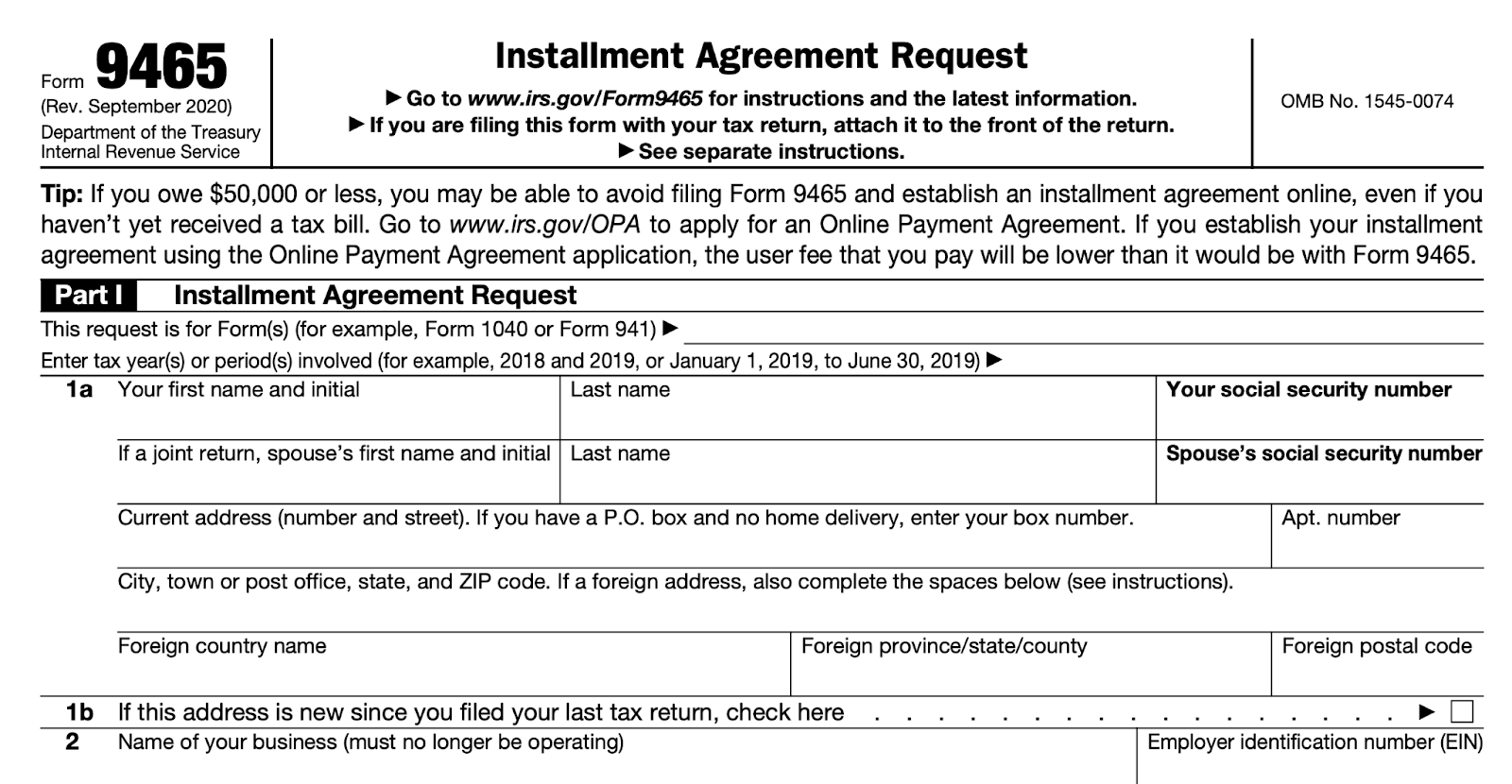
IRS Form 9465 is the form used to request a monthly installment agreement for federal taxes shown on a tax return or an IRS notice. An approved agreement lets you pay an outstanding balance over time rather than requiring immediate full payment.
An installment agreement does not forgive or reduce the underlying tax debt. Interest generally continues to accrue until the balance is paid, and applicable late-payment penalties can continue while the plan is active.
Purpose
Request permission to repay an IRS balance through scheduled monthly installments.
Not debt forgiveness
The tax remains due. The agreement changes the repayment schedule.
Costs continue
Interest and applicable penalties generally continue until the balance is fully paid.
Online option
Many qualifying individuals can apply online without mailing Form 9465.
Do You Need Form 9465 to Set Up an IRS Payment Plan?
Not always. The best application method depends on the amount you owe, whether all required returns have been filed, how quickly you can pay, and whether the account is an individual or business tax account.
Pay in Full
Paying now generally creates the lowest total interest and penalty cost.
Short-Term Payment Plan
- Generally less than $100,000 owed
- Pay in 180 days or less
- $0 setup fee
- Interest and penalties continue
Online Simple Payment Plan
- Individuals generally owe $50,000 or less
- Required returns must be filed
- Online decision may be immediate
- Setup fee depends on payment method
Form 9465 or Other IRS Resolution
- Balance above online limits
- Need a payment below the benchmark
- May require Form 433-F
- Contact the IRS or a tax professional
Who Should Use IRS Form 9465?
Form 9465 May Be Appropriate When You:
- Owe individual income tax reported on Form 1040 or 1040-SR.
- Cannot pay the full balance immediately.
- Received an IRS balance-due notice.
- Need to request monthly installments by mail.
- Are responsible for certain trust fund recovery penalties.
- Owe certain employment taxes from a sole proprietorship that is no longer operating.
Do Not Use Form 9465 When You:
- Can pay the full balance within 180 days and qualify for a short-term plan.
- Prefer and qualify to apply through the IRS online system.
- Operate a business that currently owes employment or unemployment taxes.
- Are in bankruptcy.
- Have a pending or accepted Offer in Compromise.
How to Fill Out IRS Form 9465 in 7 Steps
The form is only two pages, but the payment amount, payment date, and financial-information questions can affect whether the request is processed as submitted.
Step 1: Identify the Tax Return and Tax Period
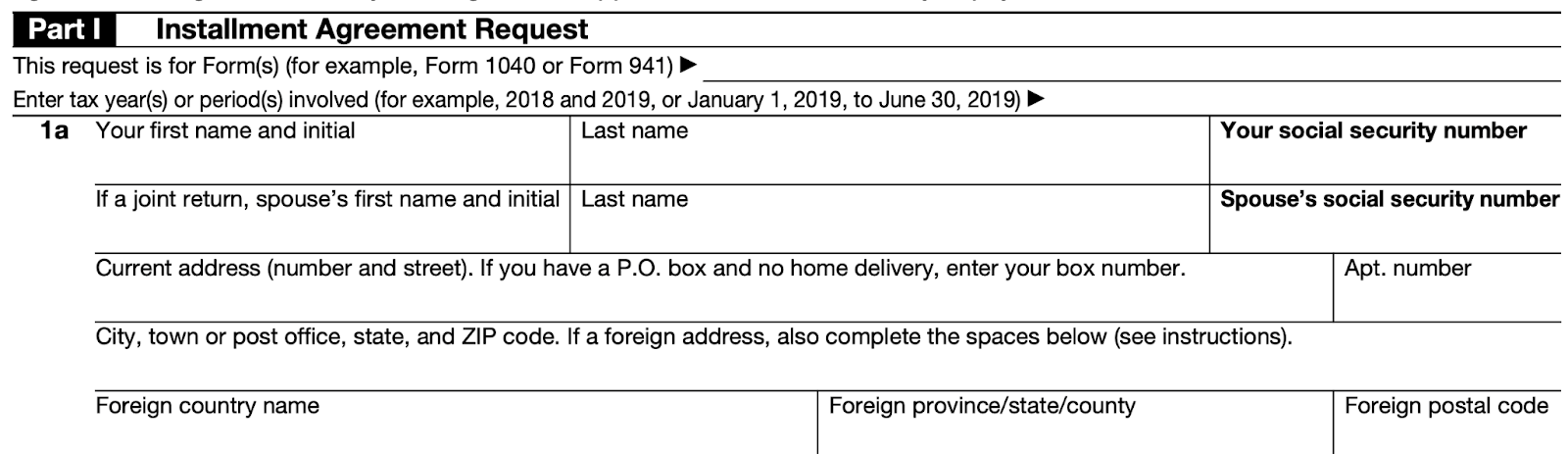
At the top of Part I, enter the type of return involved, such as Form 1040, and the tax year or periods covered by the request. Use the same information shown on the tax return or IRS balance-due notice.
Step 2: Complete Lines 1 Through 4
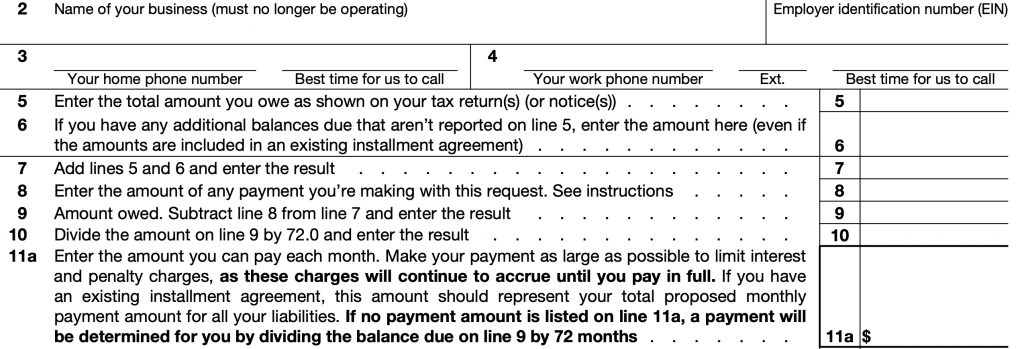
Provide your name, Social Security number, spouse’s information when applicable, current address, and telephone information. Line 2 requests a business name and EIN only where applicable; the form states that the business must no longer be operating.
Step 3: Complete Lines 5 Through 9
Line 5 asks for the total amount owed as shown on the return or notice. Add other balances on Line 6, total the amounts on Line 7, and enter any payment you are making with the request on Line 8.
Step 4: Complete Line 10 — The 72-Month Benchmark
Line 10 instructs you to divide the remaining balance on Line 9 by 72. This produces a monthly-payment benchmark used by Form 9465.
Form 9465 72-Month Payment Calculator
Enter the remaining balance from Line 9 to estimate the Line 10 benchmark.
This is only the arithmetic used on Line 10. It is not an approval, payoff quote, or estimate of total interest and penalties.
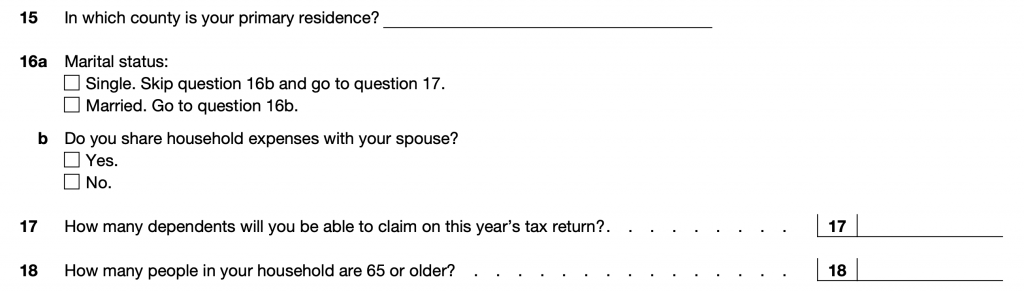
Step 5: Complete Lines 11a and 11b
Enter the amount you can afford to pay each month. The IRS form directs taxpayers to make the payment as large as possible because interest and penalties continue until the balance is paid.
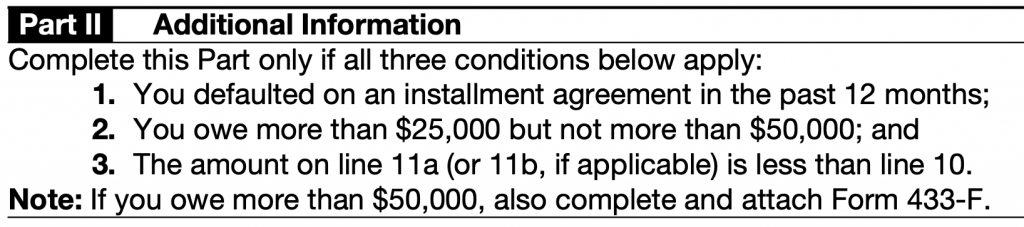
If the proposed payment is below the Line 10 amount and you cannot increase it, the IRS may require Form 433-F, Collection Information Statement. Form 433-F requests information about income, accounts, assets, housing, transportation, and other expenses.
Step 6: Choose the Monthly Payment Date
Line 12 lets you choose a payment date from the 1st through the 28th of each month. Select a date that fits your normal cash-flow cycle and leaves enough time for funds to be available.
Step 7: Choose a Payment Method, Sign, and Submit
Lines 13a and 13b are used for direct-debit bank information. Line 14 is used to request payroll deduction with Form 2159. Direct debit can reduce the risk of a missed payment and generally has a lower online setup fee.
How to Set Up a Payment Plan With the IRS
People searching for how to set up a payment plan with IRS generally have three application routes: the IRS online system, tax-preparation software, or a paper/direct-contact process.
Option 1: Use the IRS Online Payment Agreement System
For qualifying individuals, this is usually the fastest option. The IRS states that an online applicant receives immediate notification of whether the payment plan was approved.

Option 2: Submit Form 9465 Through Tax Software
Some tax-preparation software can transmit an installment-agreement request with an electronically filed return. Availability and eligibility depend on the software provider, tax return, and current IRS requirements.
Option 3: Mail Form 9465 or Contact the IRS
You can attach Form 9465 to the front of an eligible paper tax return or submit it separately after filing. Use the current IRS Form 9465 instructions to determine the correct filing address.
Individual taxpayers can call the IRS at 800-829-1040. Business accounts can call the number shown on the notice or 800-829-4933.
IRS Simple Payment Plans and Form 9465 in 2026
The IRS now describes many qualifying long-term arrangements as Simple Payment Plans. More than 90% of individual taxpayers are expected to qualify when the program requirements are met.
| Feature | Online Simple Payment Plan | Form 9465 Benchmark |
|---|---|---|
| Typical individual balance limit | $50,000 or less in assessed taxes, penalties, and interest | The paper form can be submitted in other situations, but more information may be required |
| Returns | All required returns must be filed | The IRS can deny a request when required returns are missing |
| Term | Most qualifying taxpayers may have up to the remaining collection period, often up to 10 years | Line 10 still asks the taxpayer to divide the balance by 72 |
| Financial statement | Generally not required for a qualifying Simple Payment Plan | Form 433-F may be required based on balance and proposed payment |
| Application | Individuals can apply online | Submit with a return or separately using current instructions |
How Much Does an IRS Payment Plan Cost?
The total cost is not limited to the setup fee. Interest and applicable penalties continue while the federal tax balance remains unpaid.
Setup FeeDepends on how you apply and how you pay.
InterestThe IRS underpayment rate changes quarterly.
Late-Payment PenaltyApplicable penalties may continue until paid.
Total Plan CostLonger repayment usually means a higher total cost.
IRS Payment Plan Setup Fees
| Payment Option | Current Setup Fee | What to Know |
|---|---|---|
| Pay in full | $0 | No future interest or penalties are added after full payment posts. |
| Short-term plan, 180 days or less | $0 | Interest and applicable penalties continue until paid. |
| Online long-term plan with direct debit | $29 | Automatic monthly withdrawals; qualifying low-income setup fee may be waived. |
| Online long-term plan without direct debit | $69 | Qualifying low-income fee may be reduced and potentially reimbursed. |
| Phone, mail, or in-person direct debit agreement | $107 | Manual application fee. |
| Phone, mail, or in-person regular agreement | $178 | Manual non-direct-debit application fee. |
Fees shown are current as of August 2026 and can change. Verify the amount on the official IRS payment-plan page before applying.
IRS Interest Rate
For July through September 2026, the IRS underpayment interest rate for individuals and corporations is 7% annually. Interest is generally compounded daily, and the IRS adjusts the rate quarterly.
Failure-to-Pay Penalty
The standard failure-to-pay penalty is generally 0.5% of unpaid tax per month or part of a month, up to the applicable maximum. For an individual who filed the return on time and has an approved payment plan, the rate generally falls to 0.25% per month during the approved plan.
Need working capital while you manage business obligations?
Compare funding options for payroll, materials, inventory, equipment, receivable gaps, and other business needs. Review the total financing cost and repayment structure before accepting any offer.
Use of proceeds varies by product and provider. Financing is subject to underwriting and approval.
What Happens After the IRS Approves Your Payment Plan?
Will the IRS Keep Your Tax Refund?
The IRS may apply a future federal tax refund to the outstanding balance. You generally must continue making the scheduled monthly payment even after a refund is applied.
Can the IRS Cancel the Payment Plan?
An agreement can default or be terminated if required payments are missed, new unpaid tax liabilities arise, required returns are not filed, or requested financial information is not provided. IRS collection activity may resume after termination.
Can You Pay the Plan Off Early?
Yes. Paying additional amounts or satisfying the balance early can reduce the amount of future interest and penalties that would otherwise accrue.
Frequently Asked Questions About IRS Form 9465
What is Form 9465 IRS?
“Form 9465 IRS” generally refers to the IRS Installment Agreement Request. It is used to request monthly payments when a taxpayer cannot pay the full federal tax balance shown on a return or notice.
How do I set up a payment plan with the IRS?
Qualifying individuals can apply through the IRS Online Payment Agreement system. Other taxpayers may submit Form 9465, call the IRS, or provide a financial statement for a different type of agreement.
Can IRS Form 9465 be filed online?
Some tax software can transmit an installment-agreement request with an electronic return. Many qualifying individuals can instead apply directly through the IRS Online Payment Agreement application.
What is the minimum monthly payment on Form 9465?
Form 9465 Line 10 asks you to divide the remaining balance by 72. That is a benchmark, not a universal guaranteed minimum. The IRS can approve a different amount or request Form 433-F based on the facts.
How long does the IRS take to approve Form 9465?
The Form 9465 instructions state that the IRS will usually notify the taxpayer within about 30 days, although requests associated with certain later-filed returns can take longer. Online applicants can receive an immediate determination when eligible.
Can an IRS payment plan last 10 years?
Most taxpayers qualifying for a Simple Payment Plan may have up to the remaining IRS collection period, often described as up to 10 years from assessment. The actual available term can be shorter because the collection period may have already started or may be affected by other events.
Does an IRS payment plan stop interest and penalties?
No. Interest and applicable penalties generally continue until the balance is paid. The failure-to-pay penalty can be reduced for certain individuals who timely filed and have an approved plan.
What happens if I owe more than $50,000?
You may still qualify for an installment agreement, but the IRS can require Form 433-F or another collection-information statement. Larger or more complex balances often require direct contact with the IRS or assistance from a qualified tax professional.
Can a business apply for an IRS payment plan online?
The IRS Online Payment Agreement application is currently for qualified individual taxpayers and authorized individual representatives. Business accounts must call the number on their notice or the IRS business line to request a plan.
Keep Your Business Moving With the Right Funding Option
Tax obligations can create pressure on working capital. Excel Capital helps established business owners compare financing options for recurring and one-time operating needs.
This content is educational and is not tax, legal, or accounting advice. Consult a qualified tax professional regarding IRS obligations. Financing is subject to underwriting, approval, product availability, and permitted use-of-proceeds requirements.

